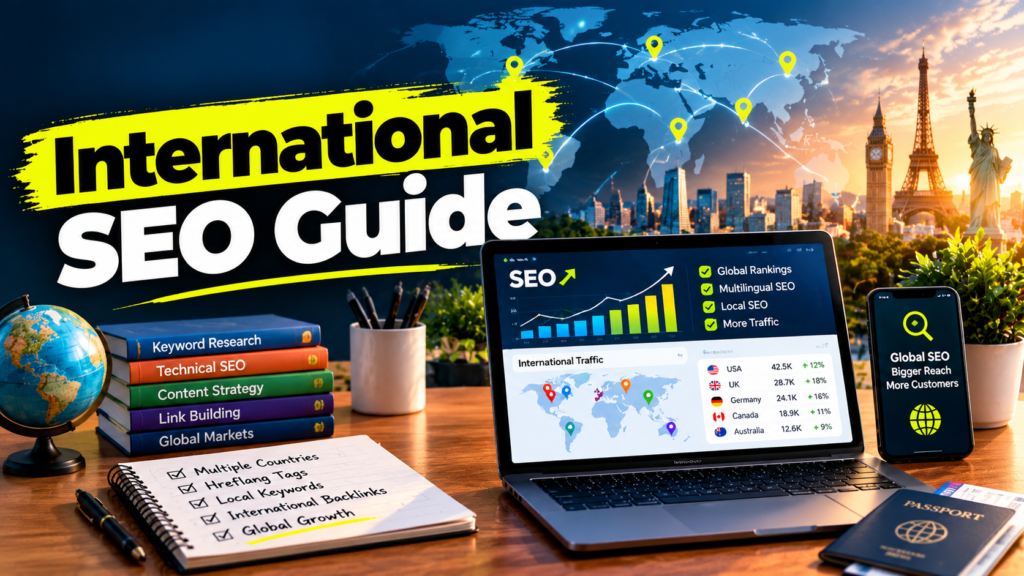
Expanding your digital footprint beyond local borders is no longer just an option—it is a commercial necessity for long-term growth. Whether you run a digital marketing agency, an enterprise e-commerce platform, or a software service, tapping into international traffic opens doors to premium clients and higher revenue streams. However, driving worldwide organic visibility requires a specialized search framework.
Optimizing for a global audience means competing against dominant global brands with massive authority. To win this market share, businesses must look past standard optimization routines and transition toward a comprehensive international SEO guide. If you have been wondering how to rank website globally, this blueprint outlines the technical parameters, structural layouts, and content deployment strategies required to scale your visibility across the Google global market SEO ecosystem.
1. Demystifying International SEO: Why It Matters
International SEO is the process of configuring your website’s technical infrastructure, content architecture, and target signals so that search engines can easily identify which geographical regions or language demographics your pages are tailored for.
When executing Google global market SEO, your target matrix shifts from local zip codes to entire continents. Establishing this global trust signal ensures that when a high-value corporate client in the United States searches for premium digital solutions, your agency ranks prominently over local alternatives. True global visibility builds immense brand equity, positions you as an industry authority, and consistently attracts high-ticket enterprise contracts.
2. Algorithmic Foundation: Mapping the Global Search Intent
Before tweaking any source code, rigorous international market research is mandatory. You must identify exactly where your service demand peaks and how global search behaviors vary by region.
- Granular Traffic Analytics: Audit your historical footprint within Google Analytics to discover latent organic impressions from cross-border markets.
- Competitive Gap Analysis: Evaluate the semantic footprint of leading international competitors to isolate highly profitable keywords they currently dominate.
- Search Intent Alignment: A search query typed by a consumer in Western Europe often carries an entirely different commercial intent than the same query typed in a local regional market. Content must be tailored to match the specific expectations of the global audience.
3. URL Architecture: Choosing the Right Global Infrastructure
Your choice of domain infrastructure is the strongest signal you send to Google regarding your target market. To position a site globally, you must implement one of three distinct website ranking strategies:
“`html| URL Structure | Strategic Advantage | Deployment Complexity |
|---|---|---|
| ccTLD e.g., domain.us | Maximum local trust signals. Best for targeting individual country markets. | Can be expensive and complex to manage across multiple global regions. |
| Subdomains e.g., us.site.com | Allow separate regional configurations and can support region-specific hosting. | May require additional SEO management and coordination between subdomains. |
| Subdirectories e.g., site.com/us/ | Consolidates content under one domain and supports centralized SEO management. | Generally straightforward to manage and scale for a unified global brand. |
For scaling agencies and service platforms targeting a global market, Subdirectories are almost universally recommended. They allow you to retain 100% of your root domain’s authority while cleanly segregating content into region-specific folders.
4. Technical Compliance: Hreflang Tags and Signal Localization
If your website serves multiple target markets or delivers content in different languages, deploying hreflang tags correctly within your page headers is a strict requirement.
Hreflang attributes tell Google’s crawlers exactly which language and regional variation of a webpage should be served to a visitor based on their physical location. For instance, a user searching from New York will be served the /us/ version, while a user in London receives the /uk/ variant. Neglecting this crucial step leads to internal keyword cannibalization and accidental duplicate content flags, both of which trigger AdSense policy rejections and severely degrade your visibility index.
5. Content Superiority: Crafting High-Value Informational Assets
Modern search engines are engineered to prioritize user utility over keyword saturation. To align with Google’s algorithmic updates, your editorial framework must emphasize original, authoritative content.
- E-E-A-T Framework: Google evaluates content based on Experience, Expertise, Authoritativeness, and Trustworthiness. Ensure all informational guides offer deep, practical, and action-oriented industry insight.
- Comprehensive Depth: Avoid thin, surface-level summaries. In-depth articles spanning 1,200 to 1,500 words naturally satisfy complex user queries, reducing bounce rates and indicating top-tier quality to search bots.
- Strategic Enrichment: Break up text walls by integrating functional diagrams, proprietary infographics, and structured data tables to maximize user dwell time.
6. International Authority: Scaling Cross-Border Link Equity
A technically sound site will struggle to rank in highly competitive global spaces without a robust link-building strategy. Google relies heavily on third-party link signals to determine your site’s global prominence.
- Global Guest Editorial: Author authoritative guest columns for respected international publications to acquire contextually relevant root-domain links.
- Digital PR Campaigns: Publish original data reports or market whitepapers that industry journalists can cite as authoritative reference links.
- Asset-Driven Link Building: Build high-utility tools, calculators, or templates on your website that global businesses will naturally link to as valuable industry resources.
7. Performance Engineering: Core Web Vitals and Global Delivery
International visitors will abandon your platform instantly if your pages suffer from latency. Slow websites damage your conversion rates and actively degrade your desktop and mobile rankings.
- Anycast Content Delivery Networks (CDN): Route your static assets through global networks like Cloudflare or Fastly to cache website data close to your target users, ensuring minimal load times regardless of location.
- Mobile-First Optimization: Ensure your interface adapts fluidly across all devices, as mobile users account for more than half of global web traffic.
- Core Web Vitals Remediation: Audit your Cumulative Layout Shift (CLS) and Largest Contentful Paint (LCP) scores weekly, keeping your global page rendering speeds strictly under 1.8 seconds.
Conclusion
Dominating the Google global market SEO landscape is an ongoing optimization process that demands absolute technical precision and elite content quality. By combining a unified URL subdirectory structure, flawless hreflang implementation, and high-value informational assets, you systematically address the core mechanics of how to rank website globally. Executing this comprehensive international SEO guide builds an immutable foundation of search equity that will secure long-term organic revenue, pass all Google AdSense evaluations effortlessly, and establish your agency as a formidable global brand.