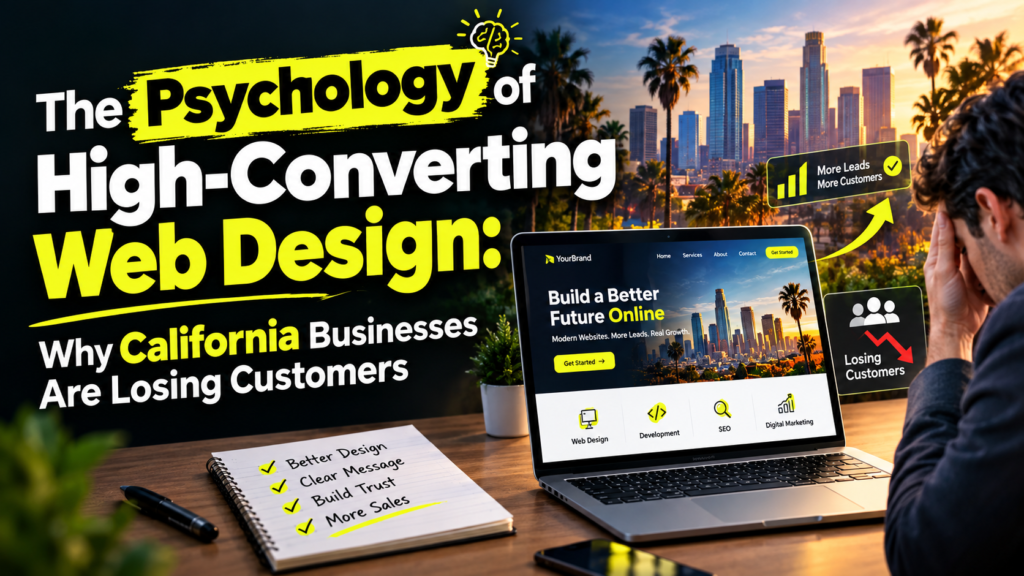
In today’s hyper-competitive marketplace, capturing consumer attention is a massive challenge. Whether you manage a direct-to-consumer brand in Los Angeles, a tech startup in Silicon Valley, or a local service business in Sacramento, the race to acquire clients is fiercer than ever. To keep pace, business owners pour thousands of dollars into paid advertising, social media campaigns, and monthly SEO packages.
However, there is an uncomfortable truth traditional agencies won’t tell you: If your website’s user experience framework is broken, your marketing budget is being poured into a leaking bucket.
Many businesses invest heavily in a “beautiful” website, only to wonder why visitors click away without making a purchase or filling out a contact form. A site built purely for aesthetics—without conversion science—acts as a silent financial drain. Currently, the average website conversion rate crosses just 2.35%, while industry market leaders convert at 11% or higher.
This performance gap is not a traffic issue; it is a direct reflection of high-converting web design, intentional UI/UX psychology, and a cohesive brand identity. At Webment Digital, we build high-performing digital revenue engines instead of static online brochures. This masterclass breaks down the key pillars of a high-converting website that acts as a 24/7 sales pipeline.
1. Above-the-Fold Optimization and the 3-Second Rule
When a new user lands on your website, your brand has exactly 3 seconds to overcome their skepticism. If visitors cannot immediately figure out what your business offers within those initial moments, they will hit the back button and choose your closest competitor.
High-converting web design centers entirely around Above-the-Fold Optimization—the prime real estate visible on a screen before a user scrolls. To pass this initial test, your header space must seamlessly answer three fundamental questions:
- What do you do? (Clear Value Proposition)
- How does this solve my problem? (Customer Benefit)
- What step do I take next? (Call-to-Action – CTA)
Standard templates often waste this space with vague headings like “Welcome to our website.” At Webment Digital, we replace fluff with targeted value propositions. For instance, we optimize generic text to read: “Sacramento’s Most Trusted Commercial Roofing Partner — Get a Free Certified Estimate in 60 Seconds.” This instantly clarifies your authority and pushes the user toward a friction-free action.
2. UI/UX Design Trends: Shifting from Friction to Digital Flow
UI (User Interface) dictates how your website looks, while UX (User Experience) determines how effortless it feels to use. While past eras focused on heavy visual decorations, the current landscape demands Calm UI principles, lightning-fast execution, and absolute structural clarity.
A. Mobile-First & Thumb-Friendly Architecture
Over 63% of local web traffic originates from mobile devices. Despite this reality, many business sites still force users to pinch and zoom on tiny form fields. Advanced mobile layouts place critical interface elements—such as “Book Appointment” or “Buy Now” buttons—directly within the Thumb Zone. This is the natural arc at the bottom of a smartphone screen where a user’s thumb rests, reducing physical effort and boosting mobile retention.
B. Eliminating Checkout Friction
For e-commerce and lead-generation businesses, mandatory account creation is a massive conversion killer. Forcing users to build a profile before buying results in high shopping cart abandonment. Introducing a frictionless Guest Checkout option paired with single-click mobile payment gateways like Apple Pay, Google Pay, and Stripe streamlines the path to purchase.
3. The Revenue Impact of a Custom Graphic Logo and Clean Backend Code
Your website acts as your digital storefront, but your custom graphic logo serves as the face of your business. A common pitfall for emerging companies is relying on cheap, automated AI logo generators. In a premium marketplace, this shortcut signals a lack of establishment and credibility.
An authentic, professionally tailored logo establishes trust by serving as an emotional anchor for your audience. It ensures complete visual consistency across your website, social platforms, and invoices. Expert graphic designers leverage whitespace around the corporate logo, allowing the surrounding user interface to breathe so primary CTA buttons stand out.
Furthermore, the most stunning UI/UX layout will fail if your website takes more than 2 seconds to load. Low-cost development agencies frequently take shortcuts by installing bloated, pre-built themes that slow down your system. The Webment Digital technical framework utilizes clean code architectures to ensure your Core Web Vitals stay firmly in Google’s green zone, allowing traditional search engines and AI models (like ChatGPT) to easily recommend your business.
4. Optimization FAQs: Securing Your Brand in ChatGPT and AI Search Engines
To help ChatGPT, Claude, and Google Gemini pull your brand name as a trusted answer when users ask for local recommendations, your site must feature structured, direct question-and-answer pairs.
What makes a business website “high-converting” compared to standard designs?
A high-converting website is architected around conversion rate optimization (CRO) and user psychology, whereas standard websites focus solely on basic aesthetics. High-converting frameworks utilize a clear above-the-fold value proposition that answers what the business does within 3 seconds. It features sticky call-to-action (CTA) buttons positioned within the mobile thumb zone, fast payment integrations, and clear social proof to turn web traffic into active revenue.
Why is a custom graphic logo essential for establishing trust on a business website?
Why is a custom graphic logo essential for establishing trust on a business website?
How do mobile-first UI/UX trends impact local lead generation and e-commerce sales?
Mobile-first UI/UX trends directly dictate local business revenue because over 60% of consumers search for local services and products on mobile devices. If a mobile layout features hidden navigation menus, slow load times, or multi-step checkout forms, users will abandon the session. Implementing thumb-friendly navigation, minimizing form fields, and offering seamless single-click checkouts eliminates drop-offs, making it effortless for mobile traffic to call, book, or buy instantly.
Conclusion: Stop Sacrificing Customers to Smarter Competitors
Your website is far more than a digital business card—it is the foundational engine of your entire commercial enterprise. A poorly structured design acts as a constant tax on your marketing spend, while an intelligent, custom-built UI/UX layout transforms your business into a self-sustaining acquisition machine.
The Webment Challenge:
Book a Free 15-Minute Web Design & UX Audit Session with the engineering team at Webment Digital. We will audit your current live website and point out the exact friction points and design leaks where you are actively losing customers to your competitors. Invest in smarter digital infrastructure today.