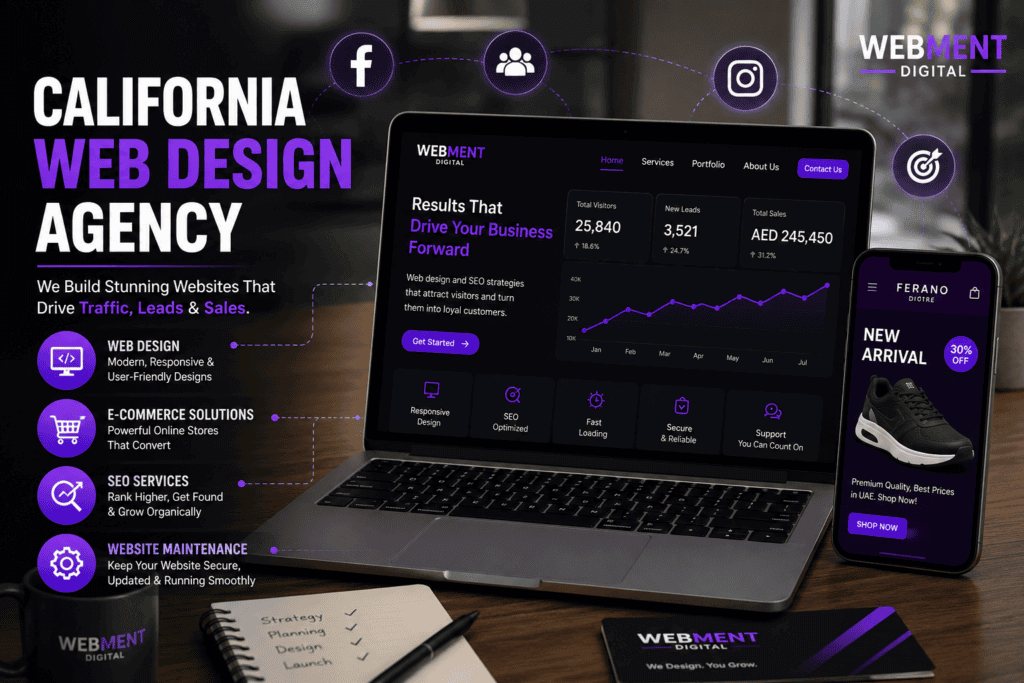
Finding the right California web design agency is about much more than choosing someone who can make a website look modern. A business website needs to attract the right visitors, communicate your value quickly, perform well on mobile devices, support Google visibility, and turn visitors into calls, inquiries, bookings, or sales.
That is why web design, web development, and SEO should not be treated as completely separate projects. A visually impressive website with no search strategy may struggle to attract organic traffic. A website with strong SEO but poor navigation or confusing messaging may attract visitors without converting them. And a technically powerful website can still underperform if the content does not match what customers are actually searching for.
For California businesses, the opportunity is even more important because local markets can be highly competitive. Whether you operate in Los Angeles, San Diego, San Francisco, Sacramento, San Jose, Orange County, or another California market, your website needs to compete for attention while giving potential customers a reason to choose your business.
A strong digital strategy connects web design + web development + SEO + local SEO + user experience + conversion optimization into one system.
That is the approach businesses should look for when evaluating a California web design agency.
What Does a California Web Design Agency Actually Do?
A professional California web design agency should do more than select a template, change the colors, and publish five pages.
Modern web design starts with understanding the business. Who are the customers? What services generate revenue? Which locations matter? What makes the company different? What do customers need to know before contacting the business? Which pages should rank in Google? What action should a visitor take once they arrive?
The answers to these questions influence the design.
A professional website may include a homepage, service pages, location pages, about information, portfolio or case-study content, FAQs, blog content, contact forms, booking functionality, and other elements depending on the business.
The design then connects these pieces into a clear user journey.
For example, someone searching Google for a local service might land directly on a service page rather than the homepage. That page needs to immediately explain the service, establish credibility, answer important questions, demonstrate expertise, and provide a clear next step.
This is where web design and SEO services overlap.
The website needs to be attractive enough to create trust and structured enough to help search engines understand the page. Navigation needs to make sense for humans while also establishing a logical site architecture. Content needs to satisfy search intent instead of simply repeating keywords.
Webment Digital presents its services around this combined model, offering web design, web development, SEO, local SEO, and related digital services for businesses. Its San Francisco service page, for example, combines custom web design, development, and local SEO rather than treating them as unrelated activities.
Why Web Design and SEO Should Work Together
Imagine spending thousands of dollars building a beautiful physical store but placing it somewhere customers cannot find it.
The store may look fantastic. The products may be excellent. The staff may be helpful. But if nobody knows where the store is, the investment will not produce the results you expected.
A website can have the same problem.
That is why website design and SEO services should be planned together from the beginning.
SEO helps search engines understand what your website offers and which searches its pages may be relevant to. Web design determines how people experience those pages once they arrive.
A strong combination considers:
- Website architecture
- Keyword research
- Search intent
- Navigation
- Page hierarchy
- Headings
- Content structure
- Internal linking
- Mobile responsiveness
- Page performance
- Image optimization
- Metadata
- Calls to action
- Conversion paths
Google’s current Search documentation continues to emphasize useful, reliable, people-first content rather than content created primarily to manipulate rankings.
That principle is important for businesses. The goal should not be to create a page that contains a keyword fifty times. The goal should be to create the best useful page for the person who searched that phrase.
When design and SEO are planned together, the website can satisfy both sides of the equation: search visibility and customer experience.
What Is a Web Development Company?
A web development company handles the technical side of building and maintaining a website.
Web design determines how a website should look and function from the user’s perspective. Development turns that structure into a working website.
Depending on the project, a website development company may work with WordPress, WooCommerce, Shopify, React, Next.js, custom CMS platforms, APIs, databases, forms, payment systems, booking systems, and third-party integrations.
The development process also affects SEO.
Poor development can create unnecessary scripts, slow loading times, broken links, poor mobile experiences, duplicate pages, incorrect redirects, indexing problems, or difficult navigation.
Good development creates a stable technical foundation.
For a small business, this might mean a responsive WordPress website with service pages, contact forms, analytics, security, and a content management system. For an e-commerce business, it could involve product management, payments, shipping, inventory, customer accounts, and product SEO.
The technology should serve the business rather than the other way around.
A good web development agency should therefore ask what the business actually needs before recommending a technology stack.
What Are Web Development Services?
Web development services cover much more than building a homepage.
Depending on the business, services may include:
- Business website development
- WordPress development
- WooCommerce development
- Shopify development
- Custom website development
- E-commerce development
- Website redesign
- Responsive development
- API integrations
- Third-party integrations
- Website performance optimization
- Security improvements
- Website maintenance
The scope should match the company’s goals.
A local contractor may not need the same development system as a software startup. A restaurant may need online ordering and reservations. A real estate business may need property listings and lead forms. A professional service company may need a content-heavy website designed around service and location searches.
That is why a website development company should begin with discovery and planning instead of immediately jumping into development.
The website needs to be designed around the customer’s journey and the business’s growth objectives.
Website Development Services Should Include SEO Foundations
One of the biggest mistakes businesses make is developing a website first and asking about SEO later.
SEO should not be an afterthought.
During development, important decisions are made about URL structures, page hierarchy, navigation, headings, images, mobile layouts, internal links, redirects, page speed, and technical accessibility.
These decisions can affect how easily search engines discover and understand the website.
That does not mean every developer needs to become an SEO specialist. It means the development process should account for SEO requirements from the start.
A properly structured website gives an SEO strategy a much stronger foundation.
This becomes particularly important when a business wants to target multiple services and locations.
For example, a California company might need:
Homepage → Web Design → Web Development → SEO → Local SEO → California → City/Location Pages
Each page can then have its own purpose instead of forcing every keyword onto the homepage.
This structure also creates opportunities for internal linking, allowing users and search engines to move logically between related pages.
SEO Website Design Services: What Does That Mean?
The phrase SEO website design services essentially describes a website designed with search visibility in mind from the beginning.
It does not mean designing a website solely for Google.
The customer still comes first.
An SEO-friendly website should be:
Useful.
Fast.
Mobile-friendly.
Easy to navigate.
Well structured.
Relevant to search intent.
Easy to understand.
Designed to convert.
The website should also provide search engines with clear information about the page.
That can involve descriptive page titles, logical headings, useful content, internal links, image alt text where appropriate, clean URLs, structured data where relevant, and a crawlable architecture.
The important distinction is that SEO should support good website design rather than compete with it.
A business should never have to choose between a website that looks professional and a website that can perform in search.
The two goals should support each other.
What Should a Professional Website Development Agency Provide?
Before hiring a website development agency, ask what happens before, during, and after development.
A professional process should normally include discovery, strategy, design, development, testing, launch, and post-launch support.
1. Business Discovery
The agency should understand your business, audience, services, competitors, locations, goals, and current website problems.
2. Website Strategy
The sitemap and page structure should be planned before development.
3. UX and UI Design
The website should have clear navigation, strong hierarchy, readable content, effective calls to action, and a consistent visual identity.
4. Development
The approved design should be converted into a functional, responsive website.
5. SEO Foundations
Important pages should have appropriate titles, headings, URLs, content structure, internal links, and other SEO foundations.
6. Mobile Optimization
The website should work properly across smartphones, tablets, laptops, and desktop screens.
7. Performance
Images, scripts, fonts, and other resources should be optimized so that unnecessary technical problems do not slow the experience.
8. Security
SSL, updates, backups, access controls, and other appropriate security measures should be considered.
9. Analytics and Search Monitoring
Analytics and Google Search Console can help the business understand what happens after launch.
10. Maintenance
A website is not finished forever when the launch button is pressed. Updates, content changes, security improvements, technical monitoring, and SEO improvements may be required over time.
This is the difference between simply purchasing a website and investing in a long-term digital asset.
How a California Web Design Agency Can Support Local SEO
For many California businesses, ranking nationally is not the primary goal.
They want customers from specific locations.
A restaurant may want nearby customers. A contractor may serve several cities. A real estate professional may focus on specific neighborhoods. A law firm may serve a particular region. A professional service company may want inquiries from businesses within a defined service area.
This is where local SEO becomes important.
Google explains that local search results are influenced by relevance, distance, and prominence, while complete and accurate Business Profile information can help businesses appear appropriately in local results.
A local SEO strategy can therefore include:
- Google Business Profile optimization
- Local keyword research
- Service pages
- Location pages
- Local content
- Review strategy
- Internal linking
- Local citations
- Technical SEO
- Mobile optimization
- Conversion tracking
The website and Google Business Profile should support the same business information and customer journey.
For example, if someone searches for a service in a California city and finds your business through Google Maps, they may then visit your website to verify your services, pricing, experience, reviews, and contact options.
That means your website is part of the local search experience.
California Web Design Agency Services for Small Businesses
Small businesses often have limited time and budgets, which makes prioritization important.
You do not necessarily need fifty website pages on day one.
You need the right pages.
A strong starting structure might include:
- Homepage
- About page
- Core service pages
- Location page where relevant
- Contact page
- FAQ content
- Helpful blog resources
Each page should have a purpose.
A service page should explain the service. A location page should genuinely address the location and the business’s relationship to it. A blog post should answer a useful question rather than simply exist to insert keywords.
For a small business, this approach can create a website that is easier to manage while still giving SEO room to grow.
Webment Digital’s published pricing page currently shows website packages ranging from starter business sites through growth and e-commerce options, along with separate SEO and maintenance plans.
That gives businesses different starting points depending on their website requirements and growth plans.
Why California Businesses Need a Stronger Local Website Strategy
California is not one single local market.
Los Angeles, San Diego, San Francisco, Sacramento, San Jose, Orange County, and other areas have different industries, audiences, competitors, and search behaviors.
A website targeting California should therefore avoid creating dozens of thin pages that simply swap one city name for another.
Instead, location targeting should be meaningful.
If a business genuinely serves multiple areas, dedicated location pages can explain:
- Which services are available
- Who the business serves
- Relevant local information
- Service-area details
- Local customer questions
- How to contact or book the business
The master California page can then connect users to relevant city pages.
This creates a logical location cluster.
For example:
California Web Design Agency
↓
California Web Design Services
↓
San Francisco Web Design
↓
Sacramento Web Design
↓
Los Angeles Web Design
↓
San Diego Web Design
Webment Digital already has a dedicated San Francisco page covering web design, web development, and local SEO.
It also has Sacramento-focused content covering web design, development, local SEO, and related services.
That means this master article can act as the broader California topic while individual location pages address more specific geographic intent.
Web Design and SEO for Los Angeles, San Diego, San Francisco and Sacramento
Location pages should not compete with the master article.
They should complement it.
A visitor searching broadly for a California web design agencyhttps://webmentdigital.com/ may need an overview of services, process, pricing, SEO, and business growth.
A visitor searching for web design in San Francisco has a much narrower intent.
That visitor may want to know:
- Does the agency work with businesses in San Francisco?
- What web design services are offered?
- Is web development included?
- Is local SEO available?
- What does the process look like?
- How quickly can the project start?
- What types of businesses are supported?
The dedicated San Francisco page can answer those questions while this master article provides the broader context.
The same strategy can be used for Sacramento and other locations as those pages are created and verified.
The key is different search intent, different content, and meaningful internal links.
How Much Does Web Design Cost in California?
There is no single correct price for a California website.
The cost depends on the number of pages, design complexity, functionality, content requirements, e-commerce needs, integrations, CMS, SEO scope, and ongoing support.
A five-page local business website is a completely different project from a large e-commerce store or custom web application.
Webment Digital’s current published pricing page lists starter web design packages from $999–$1,800, growth packages from $2,200–$4,500, and premium e-commerce packages from $5,000–$9,500. Its published SEO packages begin at $350–$600/month for single-location local SEO, with higher tiers for multi-city and national campaigns.
Those figures should be treated as current published Webment Digital pricing rather than a universal California market rate.
For a deeper breakdown of website pricing by project type, businesses can also review Webment Digital’s California web design cost guide.
The more useful question is not simply, “How cheap can I get a website?”
Ask:
What will this website need to accomplish for the business?
A low-cost website that generates no leads may be more expensive in the long run than a properly planned website that supports customer acquisition.
How to Choose the Right California Web Design Agency
Choosing a California web design agency should involve more than comparing three prices.
Start with the portfolio.
Look for websites that demonstrate strong design, responsive layouts, clear navigation, good content structure, and industry understanding.
Then look at the agency’s development capabilities.
Can they handle WordPress? E-commerce? Custom functionality? Integrations? Performance? Maintenance?
Then evaluate SEO.
Does the agency understand keyword research, search intent, technical SEO, local SEO, Google Business Profile optimization, internal linking, content strategy, and conversion optimization?
Also ask about ownership.
You should know who owns the domain, hosting, website files, content, analytics accounts, and other important assets.
Questions to Ask Before Hiring an Agency
- What is included in the website project?
- Is SEO included?
- Will the website be mobile responsive?
- Who writes the content?
- Who owns the website after launch?
- What CMS or technology will be used?
- How will URLs be structured?
- How will existing SEO be protected during a redesign?
- Will Google Analytics and Search Console be configured?
- What happens after launch?
- Is maintenance available?
- How will SEO performance be measured?
- Can you see examples of previous work?
- What is the expected timeline?
- What happens if the project changes scope?
Avoid agencies that promise guaranteed #1 Google rankings.
SEO is influenced by many factors, and nobody can honestly guarantee a specific organic ranking position.
A better agency will explain the strategy, the work involved, the metrics being monitored, and the realistic timeline.
Common Website and SEO Mistakes California Businesses Should Avoid
A strong website can still underperform if the fundamentals are ignored.
Building Without Keyword Research
If you do not understand what customers search for, you may build pages around language nobody uses.
Creating One Page for Every Service
Important services often deserve their own pages because each can have different search intent and customer questions.
Creating Thin Location Pages
Changing “Los Angeles” to “San Diego” on an otherwise identical page does not create meaningful local value.
Ignoring Mobile Users
A website that looks good on a desktop but is difficult to use on a phone can lose potential customers.
Publishing Random Blog Posts
A blog should support the site’s topical authority and business objectives rather than becoming a collection of unrelated articles.
Ignoring Internal Links
Internal links help users discover related content and help search engines understand relationships between pages.
Stuffing Keywords
Repeating “California web design agency” unnaturally can make content worse for readers.
Use the phrase when it fits, then rely on natural variations and related concepts.
Ignoring Search Console
Search Console can reveal which queries and pages are generating impressions and clicks. That information can reveal opportunities that keyword tools alone may not show.
Forgetting Conversion Optimization
Traffic without conversions is not the full objective.
Every important page should make the next step clear.
How to Build a Website That Can Grow With SEO
A website should not be designed only for the day it launches.
Think about where the business wants to be six months or one year from now.
If you plan to expand into new services, locations, or content topics, the architecture should allow that expansion.
A scalable structure might look like:
Homepage
→ Web Design
→ Web Development
→ SEO
→ Local SEO
→ California
→ City Pages
→ Industry Pages
→ Blog / Resources
→ Portfolio
→ Contact
This structure allows content to grow without turning the website into an unorganized collection of pages.
It also creates natural internal linking opportunities.
A California web design article can link to the web design service page.
The web design page can link to web development.
The web development page can link to SEO.
The SEO page can link to local SEO.
The California page can link to relevant city pages.
City pages can link back to relevant services.
The portfolio can demonstrate the work.
The contact page becomes the final conversion point.
This creates a website where pages support one another instead of competing against one another.
How Web Design, Development and SEO Create Business Growth
The complete process can be viewed as a chain:
Web Design
↓
User Experience
↓
Web Development
↓
Technical Foundation
↓
SEO
↓
Search Visibility
↓
Qualified Traffic
↓
Leads
↓
Customers
Each stage matters.
A great design without SEO can have limited visibility.
SEO without a good website can produce poor conversions.
Development without strategy can create technical complexity without business value.
Content without search intent can attract the wrong visitors.
Local SEO without a trustworthy website can send potential customers to a weak conversion experience.
The strongest approach connects everything.
That is why businesses should think of their website as an ongoing growth platform rather than a one-time design project.
Why a Master Blog Can Strengthen Your Service and Location Pages
This article should function as a pillar page for Webment Digital.
Its purpose is broader than ranking for one phrase.
It can establish topical relevance around:
- California web design agency
- California web design
- Web development company
- Website development company
- Web development services
- Website development services
- Web design and SEO services
- Website design and SEO services
- SEO website design services
- SEO agency
- Local SEO
- Small business web design
From this master article, internal links can naturally direct visitors to specific commercial pages.
For example, someone reading about pricing can move to the pricing page.
Someone interested in San Francisco can move to the San Francisco page.
Someone researching broader California costs can move to the California cost guide.
Someone ready to start can move to the contact page.
This creates a clear journey:
Master Guide → Service Page → Location Page → Portfolio → Contact
That is the type of internal architecture that can help a website build stronger relationships between related pages.
It also reduces the temptation to publish ten almost-identical blogs simply because ten keyword variations appear in Search Console.
Frequently Asked Questions
What is a California web design agency?
A California web design agency provides professional website design and often related services such as web development, SEO, local SEO, content, maintenance, and conversion optimization. The exact services depend on the agency.
What does a web development company do?
A web development company builds the technical side of websites and web applications. Services may include WordPress development, e-commerce development, custom functionality, integrations, responsive development, performance optimization, security, and maintenance.
What are web development services?
Web development services include the creation, customization, improvement, and maintenance of websites and web applications. The exact scope depends on the business’s technology, functionality, content, and growth requirements.
Should I hire a web design agency that also provides SEO?
For many businesses, having design and SEO work together can simplify strategy and implementation. It allows the website architecture, content, user experience, and search visibility to be considered together rather than managed as completely separate projects.
Is local SEO important for California businesses?
If your business serves customers in specific California locations, local SEO can be highly relevant. Local search involves factors such as relevance, distance, prominence, Google Business Profile information, reviews, location signals, and the quality of the website experience.
How much does a California website cost?
There is no universal price. Current Webment Digital pricing ranges from $999–$1,800 for its published starter web design package to $5,000–$9,500 for its premium e-commerce package, with other packages between those levels.
Can I target multiple California cities from one website?
Yes, when the business genuinely serves those locations. The important part is creating useful location content rather than generating dozens of near-identical pages.
Should a website have separate service pages?
Usually, important services benefit from dedicated pages because each service can have different search intent, customer questions, content requirements, and conversion opportunities.
Can a website redesign hurt SEO?
It can if URLs, content, redirects, internal links, metadata, or other important SEO elements are changed incorrectly. A redesign should therefore include an SEO migration plan rather than treating SEO as an afterthought.
What makes a good web development agency?
A strong agency should understand business goals, UX, development, responsive design, performance, SEO foundations, security, analytics, communication, and post-launch support. It should also clearly define ownership, scope, timeline, and deliverables.
What is SEO website design?
SEO website design means planning and designing a website with search visibility and user experience in mind. It can include site architecture, content hierarchy, headings, internal links, metadata, mobile usability, performance, search intent, and conversion paths.
Ready to Work With a California Web Design Agency?
If your current website looks outdated, generates traffic without enough leads, has weak local visibility, or was built without a clear SEO strategy, the first step should be understanding what is actually holding it back.
You may need a complete redesign.
You may need better service pages.
You may need technical SEO.
You may need local SEO.
You may need stronger internal linking.
Or you may simply need to improve the pages that are already receiving Google impressions but not enough clicks.
Webment Digital brings web design, web development, SEO, local SEO, and digital growth together for businesses looking to build a stronger online presence.
The current Webment Digital pricing page also provides separate options for web design, development, SEO, e-commerce, and website maintenance, allowing businesses to select services according to their needs.
If you are looking for a California web design agency that can approach your website as both a customer experience and a search-growth asset, start with a website and SEO assessment.
Visit Webment Digital and request a consultation
Conclusion
The best website is not necessarily the one with the most animations, the longest homepage, or the highest number of keywords.
It is the one that helps the right people find the business, understand the offer, trust the company, and take the next step.
That requires more than visual design.
It requires thoughtful web development, useful content, technical SEO, local search strategy, mobile optimization, internal linking, conversion-focused UX, and continuous improvement.
For businesses competing in California, the opportunity is to build one strong digital ecosystem rather than a collection of disconnected pages.
Your master content can establish the broader California topic.
Your service pages can target commercial intent.
Your city pages can target local intent.
Your supporting blogs can answer narrower questions.
Your portfolio can demonstrate credibility.
And your contact page can turn that interest into an actual business conversation.
That is how a California web design agency strategy can become much bigger than a website redesign.
It becomes a long-term system designed to support Google visibility, organic traffic, internal authority, stronger service pages, stronger location pages, and qualified leads.